

Set sail on a culturally enriching Scandinavian voyage
Experience the historic cities and majestic scenery of Sweden, Norway and Denmark. Read on to explore the distinctive characteristics of this northern region and learn about geography’s impact on its culinary traditions. Delve into fascinating Viking Era history and the seafaring culture of these Scandinavian people and then discover the ambitious nature of Norwegian explorer Thor Heyerdahl, who famously launched the Kon-Tiki expedition of 1947.
Scandinavia
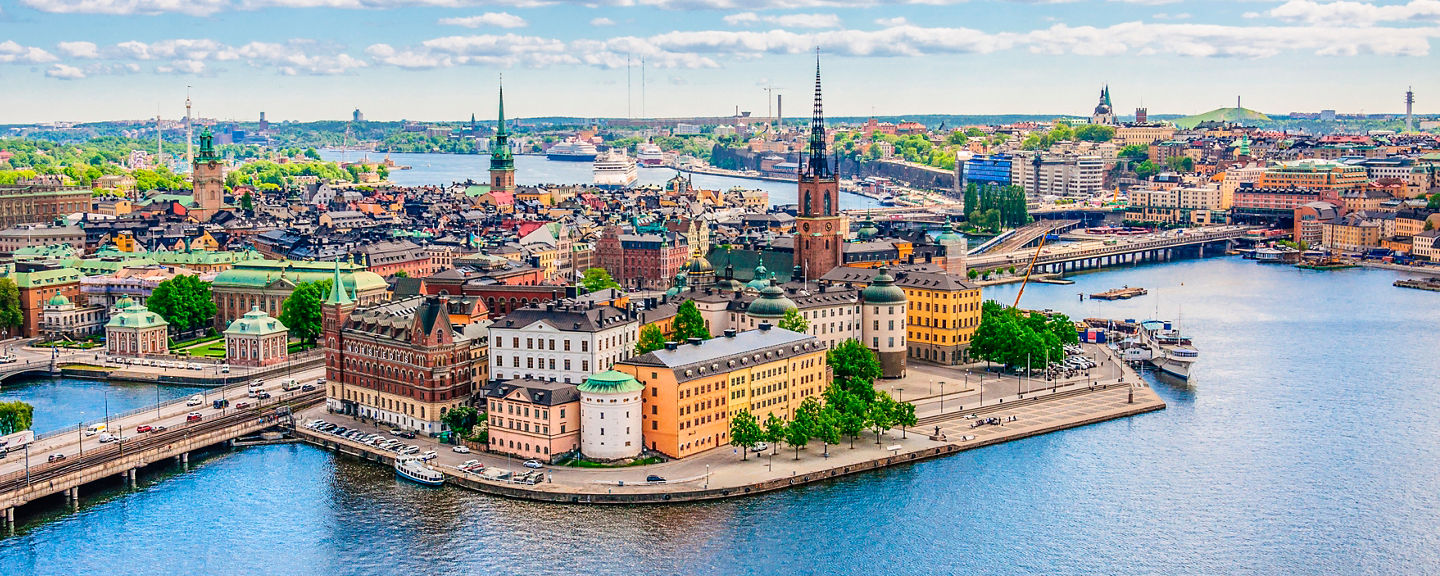
Scandinavia is a region in northern Europe that consists of Denmark and the two countries on the Scandinavian Peninsula—Norway and Sweden. Some scholars also argue for the inclusion of Finland, Iceland and the Faroe Islands due to geologic, linguistic and cultural similarities—including their shared legacies as Viking homelands. Typically, when these areas are added, the group is referred to as the “Nordic countries.”
Southern Scandinavia enjoys a temperate climate, while the central part of the peninsula has a humid continental climate characterized by warm summers and cold, snowy winters. The northernmost regions share a subarctic climate with a brief summer season and long, cold winters.
Experts agree that some of the region’s distinguishing characteristics are long life expectancies, high literacy rates, a robust fishing industry and sparsely populated northern areas. This prosperous region also boasts historic landmarks, iconic architecture and stunning natural wonders, including:
- Gamla Stan, the charming old town of Stockholm, which was founded in 1252
- Christiansborg Palace in Copenhagen, the magnificent seat of the Danish Parliament and home to the Queen’s Royal Reception Rooms
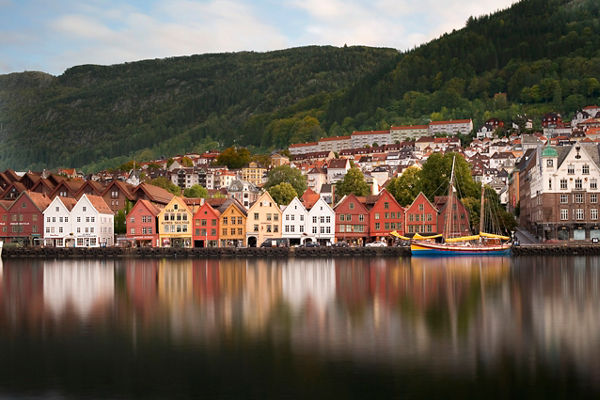
- Bryggen Wharf in Bergen, a UNESCO World Heritage Site comprised of colorful, timbered Hanseatic warehouses nestled along a scenic quay
- Norway’s stunning Geirangerfjord, a UNESCO World Heritage Site with soaring mountain slopes and cascading waterfalls
- The Munch Museum in Oslo, home to more than 1,100 paintings by the esteemed Norwegian painter Edvard Munch, including several versions of The Scream, his most iconic masterpiece
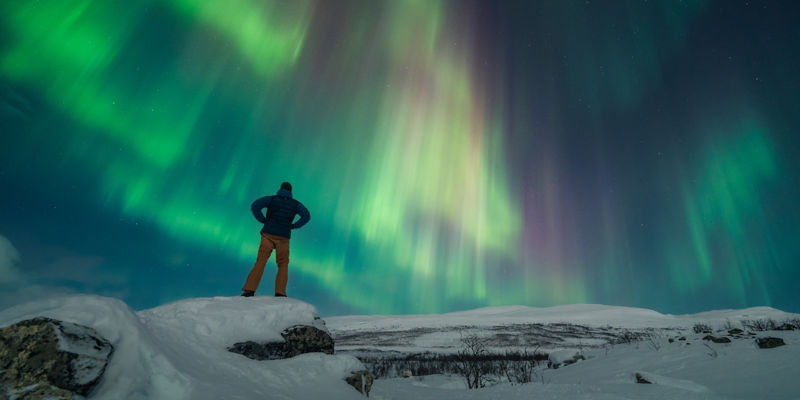
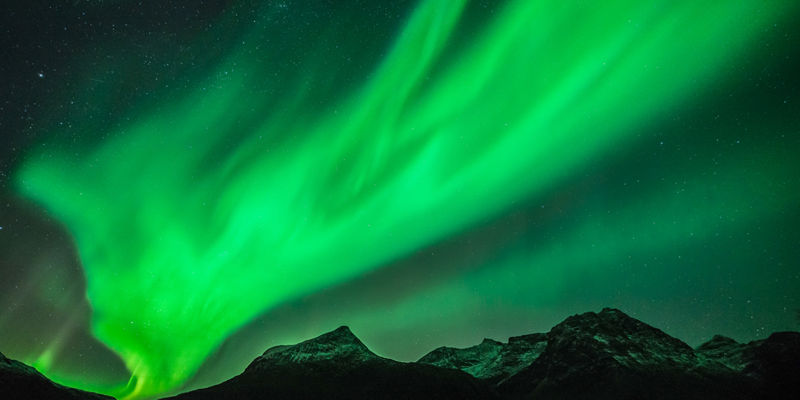
- The brilliant aurora borealis, which appears in the clear skies of the Norwegian Arctic during Scandinavia’s long winter nights
- The steaming, mineral-rich waters of Iceland’s fabled Blue Lagoon

-
Wienerbrød, or Danish pastry
Few baked goods are more closely associated with Denmark than the Danish pastry. Known for its flaky layers, buttery texture and wide variety of fillings, the pastry has become a beloved breakfast and dessert item around the world. Although it is often simply called a “Danish” in English-speaking countries, in Denmark it is known as wienerbrød, meaning “Viennese bread.”
The origins of this beloved treat date to the mid-19th century. In 1850, a labor strike among Danish bakery workers forced owners to hire substitute bakers from other countries, many of whom came from Austria. These Austrian bakers introduced Viennese techniques that differed from traditional Danish methods. Danish bakers soon adapted these recipes, incorporating more butter, eggs and sugar to suit local tastes. Over time, the results evolved into the distinctive products now recognized worldwide as Danish pastries.
The key to this delicacy is its laminated dough, which is created by repeatedly folding layers of butter into yeast-leavened dough. The dough is rolled out, folded and chilled multiple times, creating dozens of thin layers. During baking, moisture in the butter turns to steam, causing the layers to separate and produce the pastry’s characteristic light, flaky texture.
Danish pastries are available in many shapes and varieties. Some are formed into spirals, while others are shaped into pinwheels, braids or squares. Popular fillings include fruit preserves such as raspberry, strawberry or apricot, as well as custard, almond paste, cream cheese and cinnamon. Many wienerbrød are finished with icing, sliced almonds or pearl sugar, adding both flavor and visual appeal.
Traditional bakeries can be found in cities, towns and villages across the country, serving freshly baked pastries alongside coffee or tea. Danishes also dovetail nicely with the local concept of hygge—the appreciation of comfort, relaxation and simple pleasures shared with family and friends.
More than a century and a half after its creation, the Danish pastry remains one of Denmark’s most recognizable culinary exports. Combining Austrian baking traditions with Danish craftsmanship, wienerbrød continues to delight visitors and locals alike as a symbol of the country’s rich baking heritage.
-
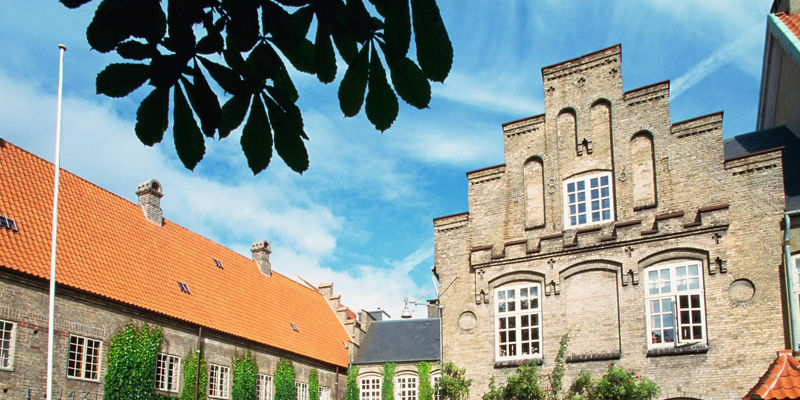
Ålborg: an architectural time machine
Founded by the Vikings, the port city of Ålborg is more than a thousand years old. Throughout its history, it has seen many architectural eras come and go, making the city itself a living architectural gallery with a collection that spans centuries and includes buildings from the Renaissance, Baroque and modern eras.
You do not have to be an architecture student to appreciate Ålborg’s diverse buildings. From the half-timbered Ålborg Castle built in the 16th century to the House of Music, which opened in 2014, Ålborg is home to many remarkable structures.
The Historic
In Ålborg’s New Square, you can visit the Gothic-style Budolfi Church (14th century), the Renaissance-style Jørgen Olufsen’s House (1616), Jens Bang’s House (1624) and the baroque-style Old Town Hall (1762). Originally built by a wealthy mayor, Jørgen Olufsen’s House is now an Irish pub.
The Modern
On the contemporary side, the House of Music is a striking performance venue and home to the Ålborg Symphony Orchestra. The Kunsten Museum of Modern Art features special exhibitions, a sculpture park and an amphitheater. And the Utzon Center on the waterfront was designed by Ålborg-born architect Jørn Utzon.
-
Famous explorers: The Kon-Tiki expedition
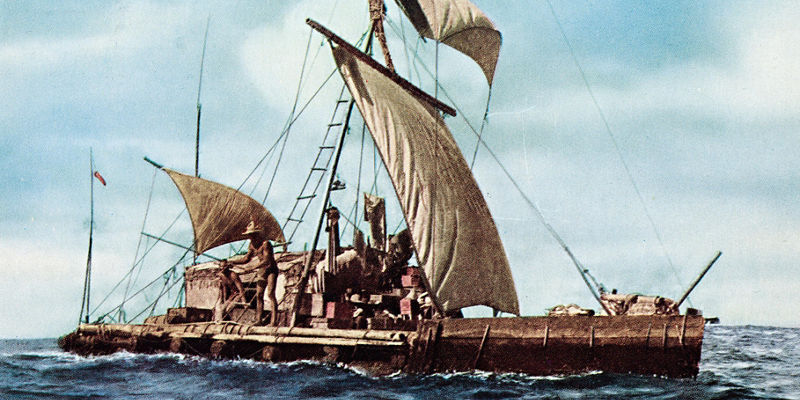
One of the boldest voyages across the Pacific Ocean, the Kon-Tiki expedition of 1947, was launched to prove a theory. Norwegian explorer and ethnographer Thor Heyerdahl (1914–2002) believed that Polynesians were descended from people who crossed the ocean from South America. He based his hypothesis on the enormous statues and stepped pyramids of Polynesia, which resemble those in Peru. Heyerdahl had also heard tales of early Europeans who had encountered islanders with a light complexion, which was consistent with stories of ancient, fair-skinned Peruvians.
To demonstrate his theory, Heyerdahl and five additional crew members built a raft from balsa logs and other Peruvian materials. They also drew references from old drawings made by Spanish conquistadors of pae-paes, large Inca rafts with sails and a small hut. Heyerdahl’s journey on this raft, bolstered by westerly trade winds, lasted 101 days and covered 4,300 mi (6,920 km).
Despite the successful voyage, Heyerdahl’s theory did not gain traction among his peers, who accepted that a west-to-east migration had populated Polynesia. Linguistic, ethnographic and botanical evidence also point to a deep connection to ancient Southeast Asian cultures.
Today, the Kon-Tiki raft is on display at the Kon-Tiki Museum in Oslo, Norway. Film lovers might remember it from the Oscar-winning documentary film released in 1950, named after the famous vessel.
-
Hans Christian Andersen and “The Little Mermaid”
Few figures are more closely associated with Denmark than Hans Christian Andersen (1805–1875). Born in the Danish city of Odense, Hans Christian Andersen rose from humble beginnings to become one of the world’s most celebrated authors. Andersen studied at the University of Copenhagen in 1828 and spent much of the remainder of his life in Copenhagen, where he developed his literary career and became an important figure in Danish cultural life. While he wrote novels, poems and travel literature, he is best remembered for his fairy tales, including “The Ugly Duckling,” “The Snow Queen,” “The Princess and the Pea” and “The Little Mermaid.”
First published in 1837 as part of Andersen’s collection Fairy Tales Told for Children, “The Little Mermaid” tells the story of a young mermaid who longs to leave the sea and experience the human world. After rescuing a prince from a shipwreck, she falls deeply in love with him and sacrifices her beautiful voice to a cunning sea witch in exchange for human legs. The mermaid must also endure constant pain, feeling as though she is walking on sharp knives with every step, and she can only gain an immortal soul if the prince falls in love with and marries her; otherwise, she will die and dissolve into sea foam when he marries another.
Unlike many modern adaptations, Andersen’s original tale is bittersweet and explores themes of love, sacrifice, identity and the desire for an immortal soul. In his version, the unsuccessful mermaid dissolves, but instead of ceasing to exist, she becomes an air spirit and ascends into the atmosphere. The story has been translated into dozens of languages and remains one of the most influential fairy tales ever written.
During the early 20th century, the tale’s connection to Copenhagen became even stronger. In 1909, Carl Jacobsen—a Danish brewer, arts patron and son of the founder of Carlsberg Brewery—attended a ballet adaptation of “The Little Mermaid” at Copenhagen’s Royal Danish Theatre. Inspired by the performance, he commissioned a sculpture depicting the story’s protagonist as a gift to the city.
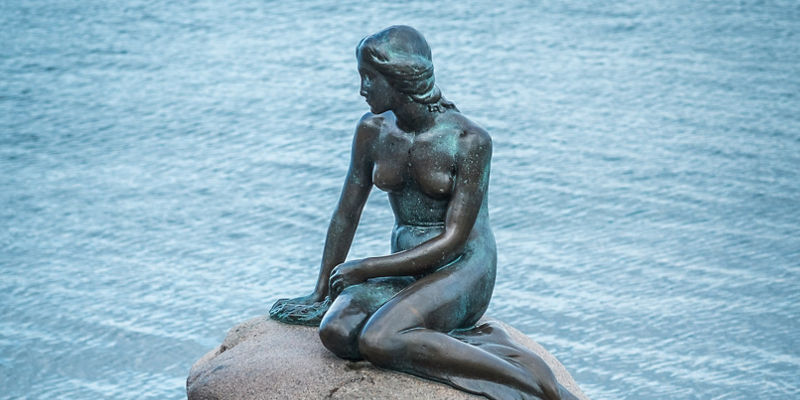
Created by Danish sculptor Edvard Eriksen, The Little Mermaid was unveiled in Copenhagen on August 23, 1913. The statue portrays the mermaid seated on a granite rock, gazing thoughtfully toward the harbor. Eriksen used ballet dancer Ellen Price, who performed the lead role in the ballet, as the model for the figure’s head, while his wife Eline Eriksen served as the model for the body.
Located along the Langelinie waterfront near Kastellet, the sculpture stands just over 4 ft (1.25 m) tall. Despite its relatively modest size, it has become Copenhagen’s most famous landmark and one of the most recognizable monuments in the world.
Although Hans Christian Andersen’s legacy can be found throughout Copenhagen—from museums and memorials to the many locations associated with his life and work—no tribute is more famous than The Little Mermaid. Together, the author, his timeless fairy tale and the waterfront statue represent a unique blend of literature, art and national identity that continues to captivate visitors more than a century after the monument’s unveiling
-
Myths & legends of the northern lights
Over the centuries, people all over northern Europe have explained the dazzling aurora borealis with equally vivid myths. Here are a few tales from different cultures of the region:
Dancing with the stars
The northern lights have been spotted in the British Isles as far south as London, though more often in northernmost Scotland. Here, the locals called the flickering arcs of light “merry dancers”—a bit of a misnomer, since the so-called dancers were thought not to be dancing, but engaging in battle.
Hear no evil
The Indigenous Sami people of subarctic Norway, Sweden and Finland thought the aurorae were the souls of dead maidens or deities such as Guovssahas, whose name means “audible light.” The northern lights do, in fact, emit strange crackling sounds, but they are difficult for the naked ear to detect. On the other hand, your chances of “hearing” the lights would be increased if you heeded the Sami warning for utter silence in their presence. Making noise of any kind might disturb the lights’ restless, fearful spirits. A more benevolent Sami legend says that the lights occur when magical fire foxes scamper across the horizon, sending sparks up into the sky.
The Viking version
Oddly, a phenomenon as powerful as the northern lights is seldom mentioned in Viking lore. Some scholars say that is because during the Viking Age (800–1100 AD), solar activity was very weak, making the northern lights a rare occurrence. They would have appeared only during unusually strong solar storms, which tended to produce red aurorae that later medieval Norse chroniclers associated with war. The famous Norse sagas of Snorri Sturluson describe a great celestial bridge called the Bivröst, which allowed fallen warriors to cross from Earth to Valhalla. Like the northern lights, it was glowing, unstable, tri-colored and fiery.
-
Notable figures associated with Copenhagen
Copenhagen has been shaped by an extraordinary range of scientists, artists and writers whose achievements have left a lasting mark on Denmark and the wider world. From Renaissance kings who transformed the city’s skyline to pioneering thinkers who revolutionized philosophy and physics, these individuals reflect Copenhagen’s enduring role as a center of culture, learning and innovation.
- Tycho Brahe (1546–1601)
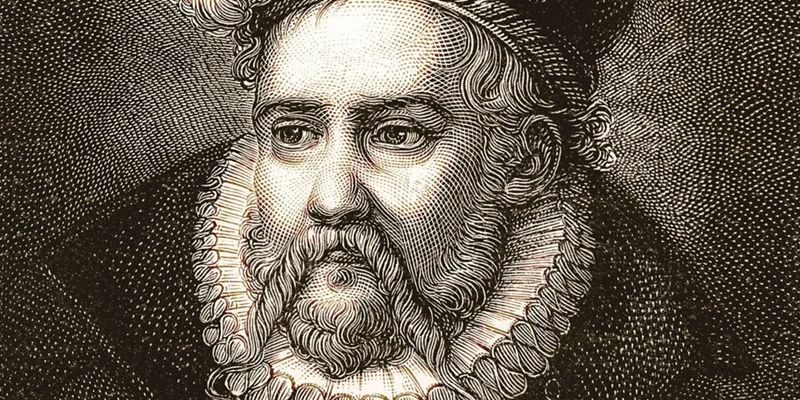
One of the greatest astronomers of the Renaissance, Tycho Brahe revolutionized the study of the heavens through his remarkably precise observations of the planets and stars. Working decades before the invention of the telescope, he collected data that later helped the German astronomer Johannes Kepler formulate the laws of planetary motion. Although best known for his observatories on the island of Hven, Brahe studied law at the University of Copenhagen, and his scientific influence extended throughout Denmark. His legacy remains closely connected to the city through institutions and monuments celebrating Denmark’s contributions to astronomy, including a sculpture at the University of Copenhagen and a bust outside the Round Tower. - King Christian IV (1577–1648)
Few individuals have left a more visible mark on Copenhagen than King Christian IV. During his nearly sixty-year reign, he launched an ambitious building program that transformed the city into one of northern Europe’s most impressive capitals. Many of Copenhagen’s most famous landmarks—including Rosenborg Castle, the Round Tower, Christianshavn and the Stock Exchange building—were constructed under his patronage. His vision helped define the city's architectural character, and his influence remains evident throughout Copenhagen's historic center.
- Bertel Thorvaldsen (1770–1844)
Widely regarded as one of Europe’s greatest neoclassical sculptors, Bertel Thorvaldsen achieved international fame for his elegant marble statues inspired by classical antiquity. After a distinguished career in Rome, he returned to Copenhagen, where he donated much of his artistic collection to the Danish people. The Thorvaldsen Museum, located beside Christiansborg Palace, was built to house his works and serves as both a museum and his final resting place.
- N.F.S. Grundtvig (1783–1872)
Bishop, poet, philosopher and educator, N.F.S. Grundtvig played a transformative role in Danish society during the 19th century. He championed education for ordinary citizens and inspired the folk high school movement, which emphasized lifelong learning, civic participation and cultural awareness. His ideas helped shape modern Danish democracy and national identity. Grundtvig’s influence continues to be felt throughout Denmark, and the monumental Grundtvig’s Church in Copenhagen stands as a lasting tribute to his legacy.
- Søren Kierkegaard (1813–1855)
Born and educated in Copenhagen, Søren Kierkegaard had an outsized influence on the development of existentialist philosophy in the 20th century. Through influential works such as Fear and Trembling (1843) and Either/Or (1843), he explored questions of faith, individual responsibility, freedom and the meaning of human existence. Much of his life unfolded in the streets, churches and cafés of Copenhagen, which served as both the setting and inspiration for his writings. Today, he remains one of Denmark’s most influential intellectual figures.
- Niels Bohr (1885–1962)
A pioneering physicist and Nobel Prize laureate, Niels Bohr transformed modern science through his groundbreaking research on atomic structure and quantum theory. Working in Copenhagen, he established the Institute for Theoretical Physics, which became one of the world's leading centers for scientific research. Scholars from around the globe traveled to the city to collaborate with Bohr, helping make Copenhagen a focal point of 20th-century physics.
- Karen Blixen (1885–1962)
Known internationally by her pen name Isak Dinesen, Karen Blixen was one of Denmark’s most celebrated authors. Her memoir Out of Africa (1937) and story collections such as Seven Gothic Tales (1934) earned worldwide acclaim for their rich narratives and literary artistry. Although she is often associated with her years in Kenya, Blixen spent much of her life near Copenhagen, where her former home, Rungstedlund, now operates as a museum dedicated to her life and work.
- Tycho Brahe (1546–1601)
-
Scandinavia’s most popular foods
Scandinavia boasts strong and diverse culinary traditions, which include game meat from the north, fish from the coasts and other products from across the region. Here are some renowned Scandinavian dishes and beverages:
- Köttbullar (Swedish meatballs)
Prepared with fresh minced meat, seasoned with aromatic spices and browned to perfection, these savory meatballs are paired with a traditional creamy, gravy-style sauce with allspice and a lingonberry condiment to balance the richness of the sauce. - Fårikål (Mutton in cabbage)
Norway’s national dish consists of mutton (or lamb) and cabbage, slowly stewed together with whole black peppercorns. Typically served with boiled potatoes, it is the perfect complement to a cool autumn day. - Nordic Gravlax
No smørbørd (open-faced sandwich) would be complete without smoked salmon, one of Scandinavia’s most distinctive dishes. “Gravlax” literally means “buried salmon,” referring to the ancient practice of curing raw fish by burying it in sand by the seashore to be saturated and cured by ocean tides. These days, fish is salted and seasoned, weighed down and refrigerated until cured. - Vafler (Norwegian waffles)
These lightly sweetened, heart-shaped treats are thinner than Belgian waffles and can be enjoyed with a variety of toppings, including sour cream, fresh berries, Norwegian brown cheese (brunost) or jam. - Aquavit
Dating to the 1500s, Scandinavian aquavit—which takes its name from the Latin aqua vitae, or “water of life”—captures pristine Nordic beauty in a bottle. In its cleanest form, it is a neutral, flavorless spirit distilled from grain or potato. Infusions of botanicals—such as caraway, dill, anise, fennel, coriander or cardamom—transform it into a pleasing elixir.
- Köttbullar (Swedish meatballs)
-
Stavanger
Stavanger is a bustling oil industry center with a small-town atmosphere. It features quaint historic neighborhoods, museums and a variety of shopping and dining destinations. But nothing compares to Stavanger's natural beauty. It is home to breathtaking fjords, mountains, white-sand beaches and Preikestolen, or Pulpit Rock. Jutting out nearly 2,000 feet above the Lysefjord, Pulpit Rock is one of Norway's most famous natural attractions.
Stavanger offers a range of cultural events and activities. The Gladmat Food Festival attracts an estimated 250,000 visitors each July. While Stavanger cuisine is increasingly international, it stays true to its Norwegian soul, incorporating fresh seafood and locally grown produce.
Oil and energy
Following the 1969 discovery of the oil field at Ekofisk in the North Sea, the Stavanger region emerged as a major driver of Norway’s economy. Today, Stavanger is Europe’s oil and energy capital, and the petroleum sector is the leading source of jobs for locals. The Norwegian Petroleum Museum chronicles the history of Norway’s offshore drilling industry.
Old Stavanger
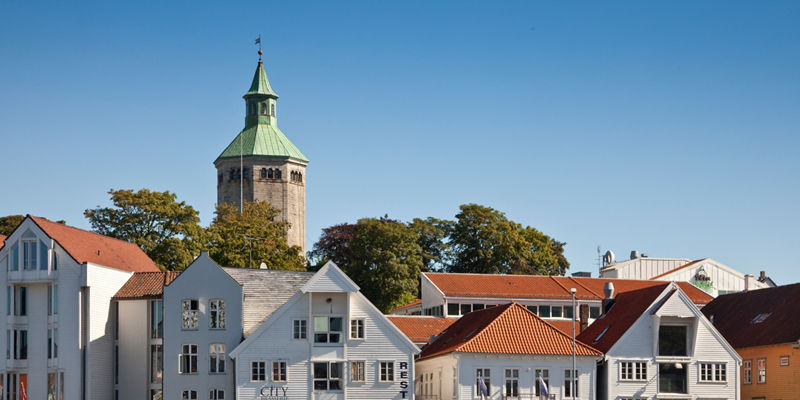
Stavanger’s Old Quarter, or Gamle Stavanger, boasts Europe’s highest concentration of wooden buildings from the 17th and 18th centuries. As you walk the charming narrow streets and admire the 170 whitewashed houses, think of Einar Hedén, the Stavanger city architect who, in the 1950s, kept the historic neighborhood from being razed as part of a post-World War II city plan.
-
The ancient Vikings
The Vikings were a group of Scandinavian seafarers who originated from areas in modern-day Norway, Sweden and Denmark. These people did not belong to a particular race or culture. Instead, the name Viking originated from the Old Norse word vik, meaning bay or creek, which in turn formed the root of vikingr, an Old Norse verb meaning to go on a waterborne journey, whether by river or sea.
The Viking Era lasted from 782–1066 AD. During that time, Vikings expanded their territorial reach far beyond their Scandinavian homelands. As pioneers in shipbuilding and navigation, they are considered by many to be the ultimate in trailblazing early explorers, with expeditions by land, river and sea. In addition to longships, Vikings’ vessels came in various forms like wide-bellied cargo ships. They had an edge over their contemporaries, as Viking ships were constructed with watertight clinker-built shells where the edges of hull planks overlapped with one another. This sturdy foundation remained a universal method of shipbuilding throughout northern Europe until the Middle Ages.
-
Top spots to see the northern lights
Evanescent. Shimmering. Always gliding across the skies, curling through the clouds and veiling the constellations in swaths of color. Though you never know exactly when or where the northern lights will appear, you can be sure that the farther north you travel and the darker the skies, the more likely you are to see this natural light show. This is why the aurora borealis is best seen in winter and why it is important to plan your itinerary for destinations where the northern lights most often reveal their splendor.
-
Unique trivia about the northern lights
- The northern lights’ soft, hazy, dynamic glow occurs when electrons in Earth’s magnetosphere collide with oxygen and nitrogen molecules in our upper atmosphere. Auroral displays appear in many colors, with pale yellowish green and pink being the most common. The pale yellowish green is produced by oxygen molecules, while rare all-red aurorae are produced by high-altitude oxygen, and nitrogen produces blue or purplish-red aurorae.
- Earth is not the only planet where the northern lights phenomenon occurs. Scientists have detected auroral activity on Venus, Mars, Neptune, Saturn and Jupiter, though these are not quite the same as on Earth and do not look the same. On Uranus, the lights do not appear as shimmering curtains but faint glowing dots.
- It was the Italian astronomer Galileo Galilei who in 1619 first coined the name “aurora borealis” after Aurora, the Roman goddess of the dawn, and Boreas, the Greek god of the north wind.
- Auroral noises were confirmed and recorded in 2012. They occur under very specific circumstances, at approximately 230 feet above the ground. Scientists do not completely understand the details of the mechanism, but the noises are now thought to be related to an inversion layer of warmer air. It isolates the negative charge on the ground from the positive charge in the air. When the difference becomes too great, the charge is released, and the energy makes the air crackle. Scientists theorize that the charge difference is altered by auroral activity, and that may be why the sounds accompany the aurorae.
- The best time to possibly see the northern lights is when the observer, the magnetic pole and the sun are aligned in a straight line. This is called “magnetic midnight.” Bear in mind that Earth's magnetic poles do not coincide with its geographic poles. So magnetic midnight is about an hour earlier than clock-based midnight.
- The northern lights occur between 60 and 400 miles above Earth’s surface. Astronauts on board the International Space Station—which orbits our planet at an altitude of between 205 and 270 miles—have front row seats to this magnificent light show.
- The earliest mention of the aurorae may be on a clay tablet in a Babylonian text from 567 BC.
- In 1989, solar storms were so strong the lights were seen as far south as Cuba!
- The northern lights’ soft, hazy, dynamic glow occurs when electrons in Earth’s magnetosphere collide with oxygen and nitrogen molecules in our upper atmosphere. Auroral displays appear in many colors, with pale yellowish green and pink being the most common. The pale yellowish green is produced by oxygen molecules, while rare all-red aurorae are produced by high-altitude oxygen, and nitrogen produces blue or purplish-red aurorae.
-
View the largest collection of Munch works at sea
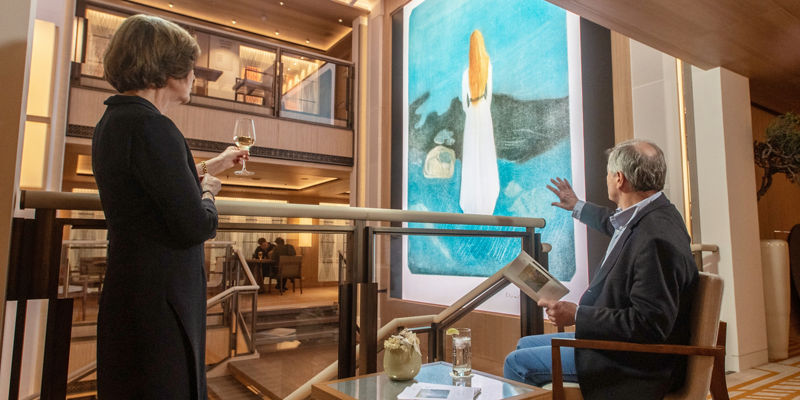
Viking has partnered with Oslo’s Munch Museum in a historic collaboration to present “Munch Moments” on board your Viking ocean ship. This is the first time the revered museum has granted digital rights to its collection of Norway’s most famous expressionist artist. We could not be more proud that ours is also the largest collection of works by Edvard Munch at sea. Each afternoon throughout your journey, several pieces of art will be projected on our giant Atrium screen in The Living Room, so you can take as much time as you would like admiring their vibrant color and lush detail. Personal and cultural insight will illuminate each work. From his famous painting The Scream to lesser known works such as The Source, Munch Moments showcase the brilliance of Norway’s beloved artist in a uniquely Viking way.
MUNCH MOMENTS
Through an exclusive relationship with Oslo’s Munch Museum, Viking has been granted the digital rights to the entire collection of Norway’s most famous artist, Edvard Munch. Our Munch Moments bring the magic of Munch to our ocean ships with a daily, interactive event that provides an opportunity for guests to learn about his extraordinary life and work.
Each afternoon, the ship’s magnificent three-deck Atrium is transformed into an interactive event of art and music. Select famous artworks are projected onto the wall of the main stairs, accompanied by evocative Norwegian compositions that reflect the different moods and themes expressed through about 50 Munch works in all.
WHO WAS MUNCH?
Edvard Munch (1863–1944) was a Norwegian expressionist painter and printmaker, and is recognized today as perhaps one of the world’s most famous artists. Munch began to paint early at the age of 12 and lived a life devoted to art. His artistic oeuvre extends over a period of more than 60 years, during which he painted more than 2,000 paintings and made tens of thousands of prints.
Munch can be said to be almost as famous for his life as he is for his art. In periods, he lived a nomadic and turbulent bohemian life, together with the Kristiania Bohemians in the Norwegian capital and with the group around the wine bar Zum schwarzen Ferkel in Berlin. During his long life as an artist, Munch experimented with the different painterly directions of his time, but it is first and foremost as a symbolist and expressionist he has become famous. Paintings such as The Scream, Madonna, Death in the Sickroom and The Dance of Life are highly praised icons in art history.
EMOTION UNCOVERED
Munch’s most famous painting, The Scream, exists in four versions. He created this masterpiece in 1893, and the onboard painting is a later version from 1910. The motif is inspired by an experience Munch describes in a poem in his diary in 1892. “I was walking along the road with two friends—the sun was setting—suddenly the sky turned blood red—I paused, feeling exhausted, and leaned on the fence—there was blood and tongues of fire above the blue-black fjord and the city—my friends walked on, and I stood there trembling with anxiety—and I sensed an infinite scream passing through nature.” The same swirling brush strokes are used in a 1894 bare-torso Madonna, an oil on canvas piece.
There are many coastal pictures on display painted from Munch’s property overlooking the Norwegian fjords. It has been said that he often asked his coachman to halt at the plateau above his vacation home to admire the view there of the Oslofjord. He liked to stand at his easel in wind and weather and paint nature scenes by the fjord in all seasons. When Munch moved back to his hometown in 1909, the pessimistic undertone that had become prominent in much of his earlier works faded quite a bit, and he took more of a colorful, playful approach with his paintings. This is clear in his later works.


Scandinavia Highlights
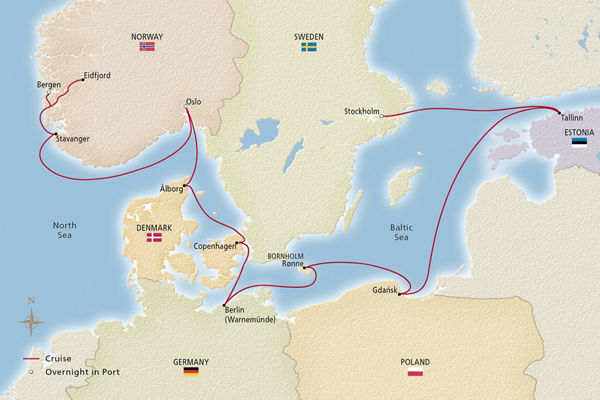
From soaring, deep-cut fjords and dramatic peaks to historic Scandinavian cities and fishing villages rich in tradition, immerse yourself in remarkable maritime history and colorful cultures. Here are some sample highlights of a cruise to Scandinavia:
- The Hanseatic past of Bergen
- Traditional glassblowing techniques in Bornholm
- Norway’s magnificent fjords
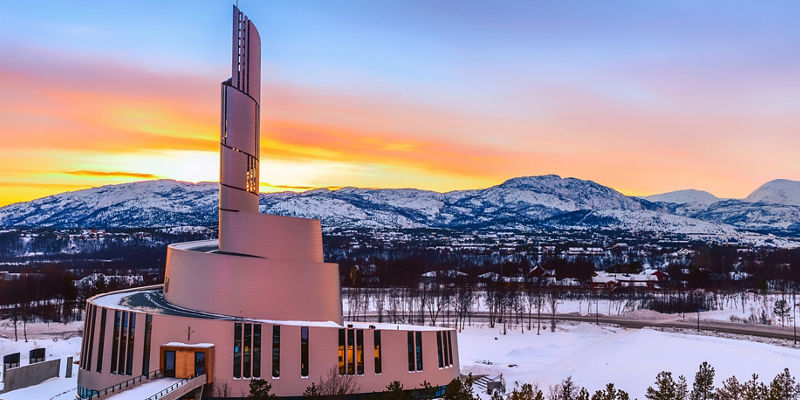
- The glass facade of Tromsø’s Arctic Cathedral
- A Sami ceremony north of the Arctic Circle
- Sheep farming and wool production in a Faroese village
- The age-old tradition of smoking fish
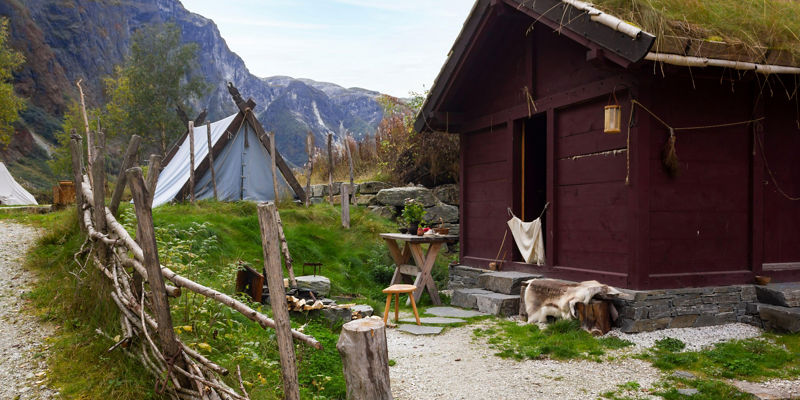
- Stories of the daily life of ancient Vikings
- Copenhagen’s brightly colored houses in Nyhavn
- The dazzling display of the northern lights
Destination Insight Videos

Explorer Leif Eriksson (3:32)
Join Viking as we chronicle the story of Leif Eriksson, the Norse navigator who set out to explore the seas west of Greenland and discovered America, 500 years before Columbus.

The World of Edvard Munch (2:36)
Join Karine on a journey into Oslo’s renowned Munch Museum, where you will enter the world and mind of master expressionist Edvard Munch, painter of The Scream and more than 40,000 pieces of art.

The Queen of Smørrebrød (5:48)
Taste Denmark’s famous open-faced sandwich and perhaps try Hans Christian Andersen’s favorite variety. Watch as Copenhagen’s celebrity chef Ida Davidsen prepares these delicious treats.


Scandinavia Travel FAQ
Enriching Itineraries—Scandinavia
Choose one of our immersive voyages and discover the many benefits of exploring in Viking comfort.